Is Beam the Missing Piece in Your Development Stack?
Fast bids vs. full-stack automation: choosing the right engine for your workflow
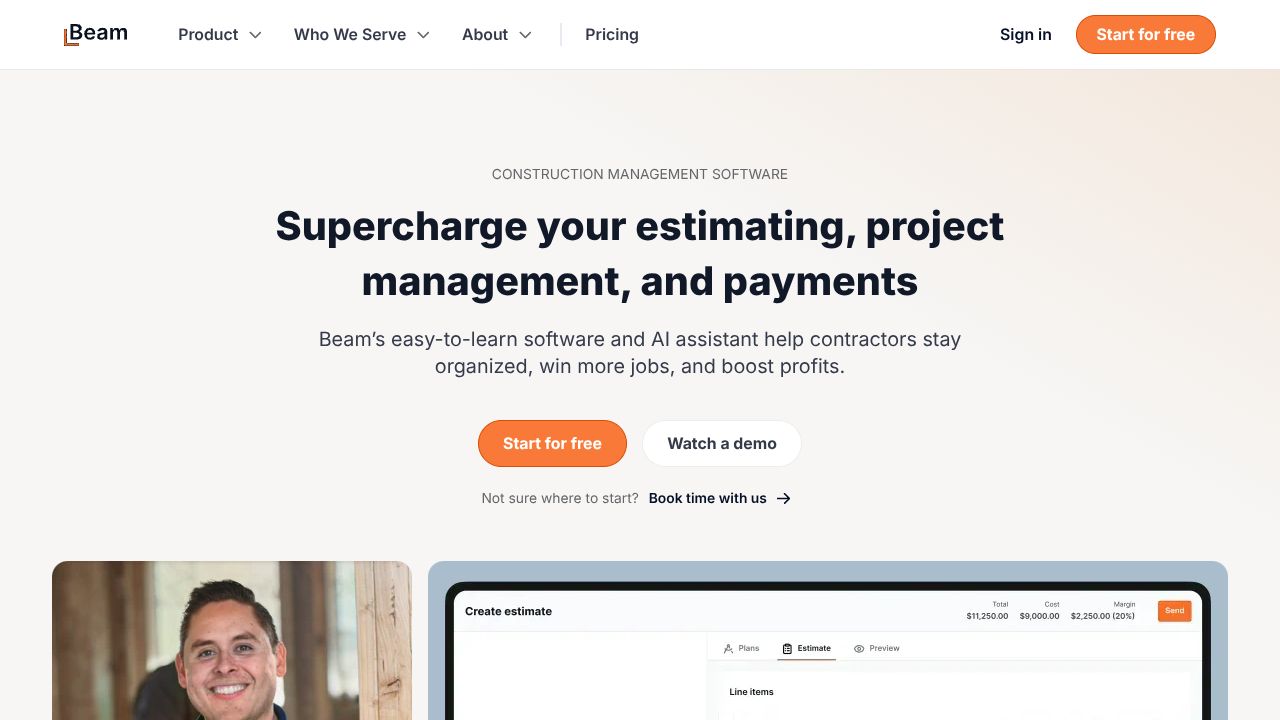
Picture this: it’s 4:45 p.m. on bid day, and a builder just emailed a 40-page plan set. You can either burn a night doing takeoffs—or drop the PDFs into Beam and get a defensible estimate before dinner. In automation terms, Beam is a domain-specific “estimation engine” that converts unstructured inputs (plans, site notes) into structured cost breakdowns. The question for Developer Tools professionals is whether Beam’s narrow focus beats general-purpose automation platforms like Origami Agents, Creatio, and HeyReach in speed, integration, and architectural fit.
Quick Comparison Table
| Feature | Beam | Origami Agents | Creatio |
|---|---|---|---|
| Pricing | Unknown | Public, usage/seat-based tiers (varies by deployment) | Public, tiered per-user and add-ons (varies by module) |
| Ease of Use | Upload plans/notes → estimate in minutes; minimal setup | Moderate; requires agent design, prompts, loops, data connectors | Moderate-to-high; low-code studio with modeling, governance |
| Developer Tools Features | Domain-specific estimation engine; limited extensibility noted | Agent orchestration, SDKs, complex logic (loops, tools) | Low-code + pro-code extensibility, APIs, data model, BPM |
| Integration Options | Builder workflow integrations; file upload pipeline | Broad integrations via connectors and APIs | Large ecosystem: CRM, BPM, data connectors, marketplace |
Where Beam Wins
- - Purpose-built plan-to-estimate pipeline: While Origami Agents excels at building flexible AI agents with loops and tool-calling, Beam specializes in extracting quantities and costs directly from uploads. For teams optimizing “time-to-first-estimate” (TTFE), Beam’s single-purpose architecture avoids the design overhead of agent orchestration.
- - Minimal setup, high signal: Compared to the configuration layers in Creatio, Beam’s workflow is simple—drop in PDFs or site notes and receive a draft bid in minutes. Our analysis prioritizes early-bid latency and cognitive load; Beam keeps both low by constraining scope to construction estimation.
- - Domain accuracy over generic automation: Outreach and CRM automations (e.g., HeyReach, Creatio) optimize for messaging and workflow states. Beam’s differentiator is quantity takeoff and cost calculation. For builders and small contractors, this domain specificity tends to yield more actionable output with fewer refactors to reach “good enough.”
Where Competitors Have an Edge
- - Broader automation canvas: If you need multi-step, cross-department flows (procurement approvals, CRM sync, follow-up outreach), Creatio offers a mature low-code platform with BPM, data modeling, and governance. Beam’s scope is intentionally narrow.
- - Complex logic and agent patterns: For teams exploring toolformer-style agents, retries, and looped reasoning across heterogeneous tasks, Origami Agents provides richer control surfaces (tools, memory, branching). Beam focuses on a single, well-defined task rather than an agent platform.
- - Ecosystem and extensibility: Sales engagement stacks often pair with enrichment, sequencing, and analytics. HeyReach slots into these patterns with outbound-specific features, whereas Beam’s integrations are tuned to builder workflows and may feel limited for cross-functional ops teams.
Best Use Cases for Developer Tools
- -
Choose Beam when:
- - You need rapid conceptual estimates from plan PDFs or site notes without assembling an agent graph or low-code model.
- - Your architecture pattern is event-driven ingestion: file upload → extraction → estimate JSON → export to downstream systems (ERP, spreadsheet, or cost database).
- - Developer priorities are TTFE, predictable outputs, and minimal glue code. Treat Beam as a specialized microservice in your pipeline.
- -
Choose Origami Agents when:
- - You’re building agentic automations with loops, tool use, and conditional branching across multiple tasks (RAG, enrichment, scheduling).
- - You want fine-grained control and extensibility patterns (SDKs, custom tools, evaluation harnesses).
- -
Choose Creatio when:
- - You require end-to-end workflow orchestration with strong data modeling, role-based access, and auditability across sales/ops/field teams.
- -
Choose HeyReach when:
- - Your core loop is sales outreach automation unifying email and LinkedIn, with sequencing and inbox management at scale.
Implementation best practices:
- - Architecture Patterns: For Beam, favor a queue-backed ingestion service and idempotent processing for re-runs on revised plans. Emit structured estimate JSON with schema versioning.
- - Code Quality Tools: Validate cost formulas with unit tests and golden files for typical plan archetypes. Add confidence scores to extraction fields.
- - Refactoring Guides: Abstract estimator integration behind an interface to swap Beam with manual takeoff or alternative engines without touching downstream code.
The Verdict
For teams “building better code, one week at a time,” Beam is a high-leverage, domain-specific accelerator: it turns unstructured construction inputs into bid-ready estimates with minimal orchestration. If your priority is fast, accurate early-stage bids, Beam is the right tool to slot into a microservice-style pipeline. If you need broader automation across CRM, outreach, or multi-step agent logic, Creatio, HeyReach, and Origami Agents offer wider canvases with richer extensibility.